
VAP GROUP REINFORCES ABU DHABI AS AI ECOSYSTEM CENTRE


The Global AI Show Abu Dhabi 2025, held December 8–9 at Space42 Arena, emerged as a defining hub for AI innovation—uniting 5,000+ leaders, 200+ speakers, and 300+ companies under the theme “AI 2030: Accelerating Intelligent Futures.” From generative AI to ethics and national strategy, it sparked collaboration between global tech and regional vision. Powered by Times of AI and VAP Group, the future of intelligence is being built—right here.
Themed “AI 2031: Accelerating Intelligent Futures,” the Global AI Show sparked vital conversations on ethical, inclusive AI shaping the decade ahead. Policymakers, technologists, and regulators collaborated on governance, cybersecurity, and fairness—balancing innovation with responsibility. A united front for a smarter, safer tomorrow.

AGI could fundamentally reorder society, economy, and human cognition. Dr. Grace. S. Thomsun highlighted that AI governance is essential to manage these risks, focusing on binding international frameworks, ethical development, and safety protocols for agentic AI.
Key Observations from Global AI Show Abu Dhabi 2025:
AGI Safety & Regulation: Experts warned of the need for immediate, proactive regulatory frameworks for AGI and agentic AI systems to prevent the dissemination of harmful information.
The Age of Intelligence: The UAE emphasized its position as a global AI hub, closely aligning with its 2031 strategy. Key focus areas include AI-driven healthcare, decentralized finance, and autonomous defense technologies.
Global AI Governance: Discussions moved toward binding international agreements rather than just guidelines.
Data-Driven Governance: AI is being integrated into public services for greater transparency, efficiency, and evidence-based policy.

Role of AI Governance in the Age of AGI:
Risk Mitigation: Preventing catastrophic failures and ensuring safety in systems with near-human or superhuman capabilities.
Ethical Frameworks: Developing, auditing, and implementing ethical standards to ensure AGI aligns with human values.
Standardization: Establishing international standards for AI interoperability and security.
Transparency & Accountability: Ensuring that decisions made by AI systems, especially in public sectors, are transparent and accountable.
Societal Stability: Managing the economic impact of AGI, including potential job displacement and wealth distribution.

At the Global AI Show 2025 in Abu Dhabi, H.E. Dr. Mohamed Al Kuwaiti highlighted that AI-driven, real-time intelligence and autonomous systems are essential for the future of national cyber resilience. Key takeaways focused on shifting from reactive to predictive crisis management and cementing the UAE’s leadership in secure digital ecosystems.
Key Takeaways from H.E. Dr. Mohamed Al Kuwaiti’s Keynote:
Real-Time Intelligence & Threat Detection: AI enables immediate identification of sophisticated cyber threats, moving beyond traditional security measures to analyze vast datasets in real-time for faster, more accurate detection.
Autonomous Incident Response: The future involves AI systems capable of autonomously detecting, isolating, and neutralizing cyber threats without waiting for human intervention, significantly reducing “dwell time” (time attackers spend in a system).
Predictive Crisis Management: Instead of just reacting, AI will be used to simulate and predict potential crises, allowing for proactive defense strategies and better preparedness for national-level digital emergencies.
Strengthening National Resilience: The integration of AI is not just for efficiency but is vital for securing critical national infrastructure and fostering a robust, future-ready digital economy, aligning with the UAE’s strategic goals.
AI for Secure Ecosystems: The focus remains on leveraging AI to create “safe by design” digital ecosystems, enhancing trust in automated, AI-driven technologies.
Dr. Al Kuwaiti emphasized that this transformation is essential for the UAE to maintain its global leadership in cybersecurity.

In this presentation at the Global AI Show 2025, Dr. Hyunjin Kim, Strategy Professor at INSEAD, outlines how companies can move beyond mere productivity gains to fundamentally reimagine their business models using AI to build the next generation of startups.
Key Observations
The Three Core Facts of AI Evolution:
Unprecedented Pace: AI capabilities are doubling every 6 to 12 months.
Record Adoption: AI is adopting faster than any general-purpose technology in history; ChatGPT reached 200 million users in two months, compared to eight years for the internet.
Elusive Returns: Despite rapid adoption, most firms are seeing little impact on their bottom line because they are focusing on the wrong metrics
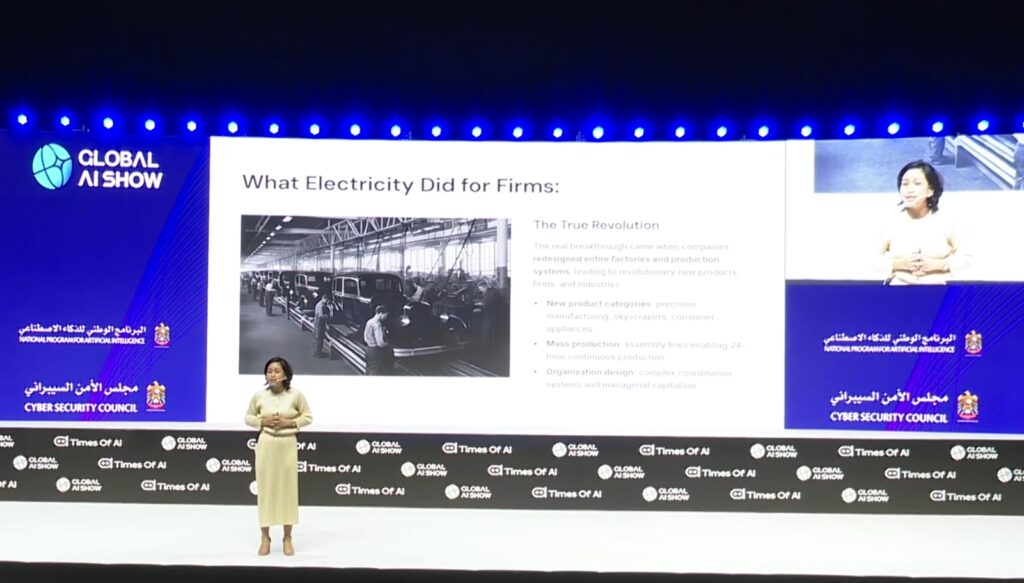
Reimagining vs. Optimizing:Most companies are using AI merely to make existing processes cheaper or faster (task-level productivity).
Real transformation occurs when AI is used to reimagine what a business can do, creating entirely new products, business models, and structures.
Analogy: True revolution doesn’t come from replacing steam engines with electric motors in old factories, but by redesigning factories for mass production entirely.
Characteristics of AI-Native Startups:
They are roughly 30% smaller in team size.
They build and launch much faster.
Their success is 10 times more predictable based on early data (first two quarters) compared to non-AI startups.
They generate 20% higher value per dollar invested.
Three Key Principles for AI Strategy:Invest Now: The pace of change is too fast to catch up later.
Don’t Automate Everything: Identify small, key bottlenecks in workflows rather than trying to automate entire departments.
Start from First Principles: Ask, “What becomes possible only with AI?”.
Conclusion:If the Industrial Revolution scaled production, the AI Revolution scales creation
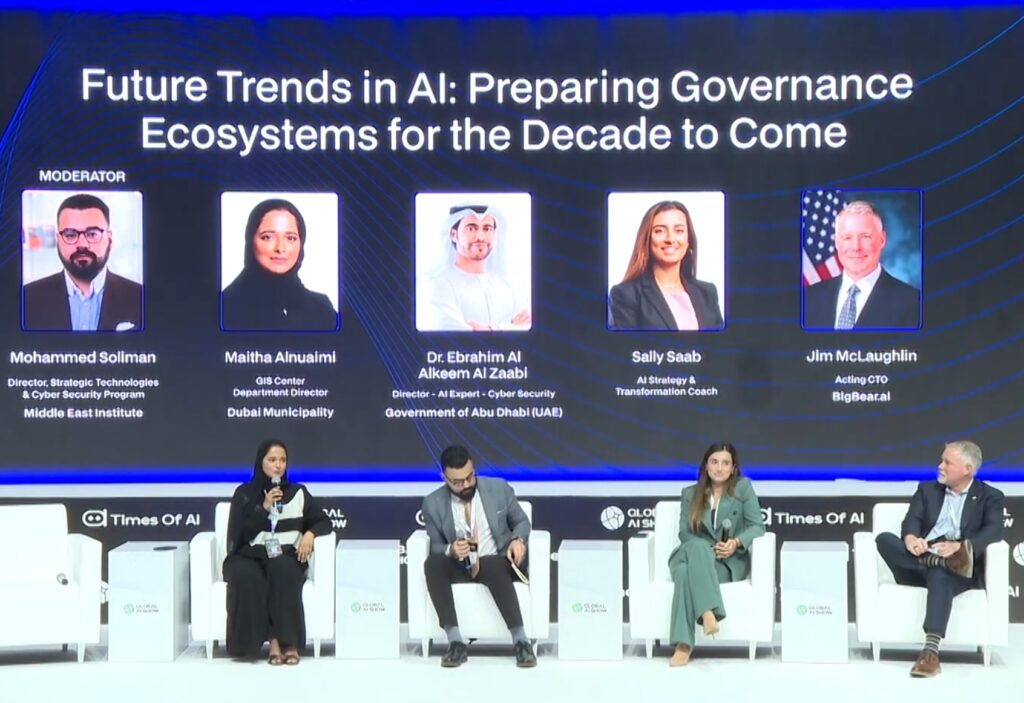
The key takeaways from each speaker in the panel discussion “Future Trends in AI: Preparing Governance Ecosystems for the Decade to Come” at GAIS 2025.
Moderator: Mouhamad M. Soliman (Director, Middle East Institute)
Differentiating AI Layers: He emphasizes separating the infrastructure side (compute demand) from the application/wrapper layer. While infrastructure demand is high and necessary, the application layer may face a market correction.
Historical Parallels: He draws a parallel to the 1990s biotech bubble, suggesting current AI investment patterns are setting the stage for future essential technologies.
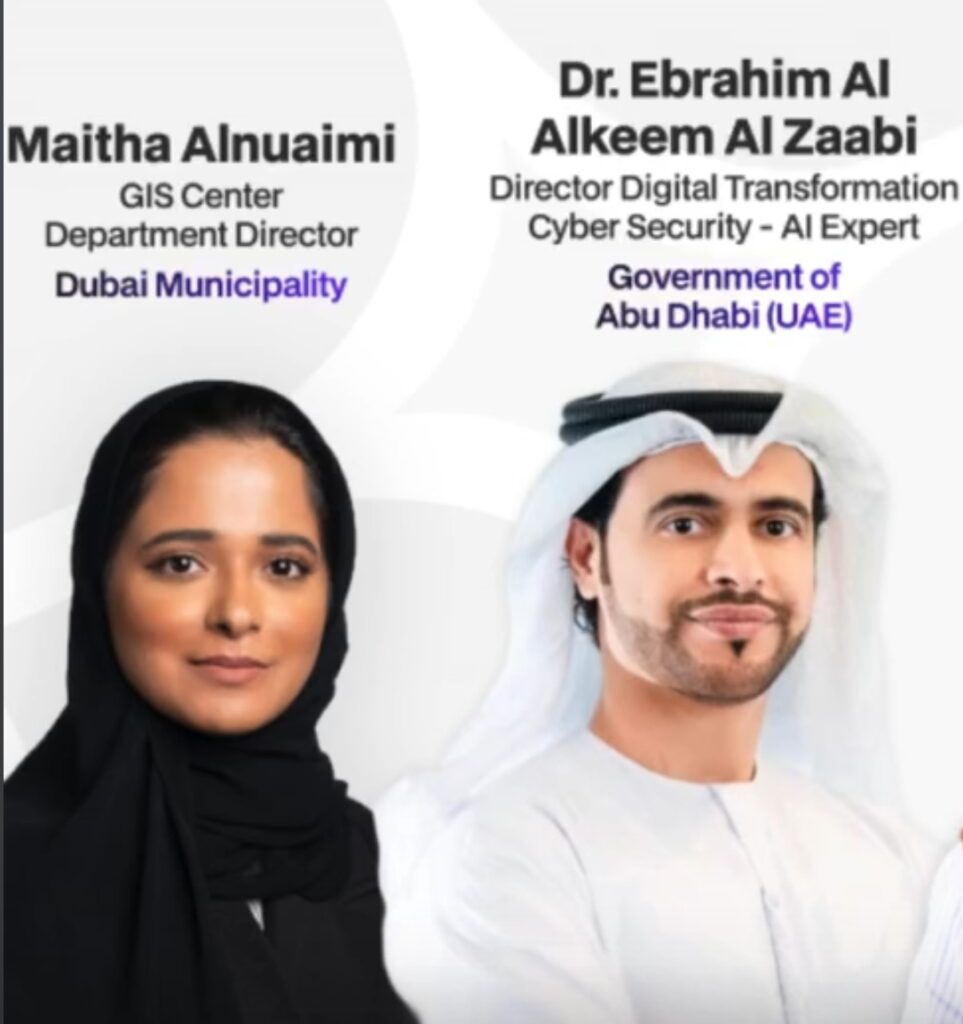
Dr. Maitha Al Nuaimi (Director, GIS Center Department, Dubai Municipality)
Predictive Urban Planning: Dubai is shifting from reactive to proactive planning using geospatial data and AI to predict citizen needs, such as ensuring essential services are within a 20-minute accessibility radius.
Data as Fuel: High-quality data is the fundamental fuel for innovation. The focus is on clearing and preparing legacy data for AI models, which is described as difficult but essential work.
Balancing Governance and Access: Dubai maintains a balance between high-security measures for data protection and providing access to startups to foster innovation.

Sally Saab (AI Strategy and Transformation Coach)
Strategic Focus Over Tools: 80% of AI agent use cases fail because companies focus on buying tools rather than defining strategy, processes, and data governance.
Human-AI Collaboration (Future of Work): Workforce transformation requires upskilling based on specific “personas.”
Humans should focus on the four C’s: Creativity, Critical Thinking, Continuous Learning, and Communication.
AI Champions Network: Implementing AI successfully requires “AI champions” within business units to act as translators between subject matter experts and technical teams.

Jim Mclaughlin (Acting CTO, Big Bear AI)
Uncapping Human Potential: AI should be used to free humans from “dirty, dangerous, and repetitive” jobs, allowing them to focus on higher-order cognitive tasks.
Data Preparation Bottleneck: Technical model development is becoming trivial due to compute power, but 80% of the effort remains in data preparation and curation.
Mission-Focused AI: AI implementation must be grounded in specific use cases and domain expertise to be effective, rather than applying general models blindly.