

VELOCITY OF INDIAS INTELLIGENT FINANCIAL SECTOR


“The Long Game: Pension Funds, Patient Capital & India’s Growth Ambitions” stood out as a pivotal conversation at the Four Seasons on September 18, 2026 — not just another panel, but a focused exploration of how long-term capital can fuel India’s next phase of growth. Held within a broader ecosystem of financial leadership events, it brought together institutional investors, policymakers, and fund managers to ask the hard questions: How do we move from short-term wins to sustained impact? Can pension flows be structured to back infrastructure, innovation, and inclusion — not just returns? And what does it take to build a financial system where patience is rewarded, not punished? It was a session that didn’t just track capital — it reimagined its role.

The Experts’ Session, “The Intelligent Market Infrastructure: AI, Data & the Future of Financial Decision-Making,” was moderated by Ms. Hetal Shah (Partner, PwC India) and featured Mr. Aniruddha Chatterjee (CEO, NSE Cogencis), Mr. Jigar Shah (CFO, NSDL), and Mr. Rohit Valia (CEO, Tumeryk, Inc.) highlighted the shift toward an intelligent financial ecosystem driven by Agentic AI and multi-dimensional data for real-time forecasting and risk management. Panelists from PwC India, NSE Cogencis, NSDL, and Tumeryk stressed that the value of predictive AI depends on trusted data foundations to eliminate algorithmic bias and ensure regulatory compliance. Ultimately, this AI-driven transformation provides the resilient infrastructure necessary to attract long-term patient capital into India’s growth sectors. More information is available from the event organizers.
The panel heavily emphasized that as India’s market infrastructure rapidly scales, institutions must prioritize systemic reliability and dependability over mere transactional velocity. To maintain foundational trust among investors, the integration of advanced technology requires embedding domain-specific artificial intelligence as an end-to-end operating layer rather than a superficial tool, successfully transitioning legacy setups into robust decision intelligence platforms.
Furthermore, the operationalization of AI demands strict frameworks around security, compliance, and data governance to counter the risks of “cognitive convergence”—where synchronized systemic errors could occur due to multiple institutions relying on identical data models. Panelists highlighted the critical need for deploying adaptive validation methods and an AI Trust Score to ensure proper oversight before autonomous agents are granted high levels of operational agency. Ultimately, building and securing this intelligent data spine requires a massive infusion of long-term capital. The discussion seamlessly bridged into the conclave’s primary focus on patient capital, emphasizing that long-duration asset pools, like pension funds, are essential vehicles to fund the intensive compute, networking, and data center infrastructures underpinning India’s financial future.
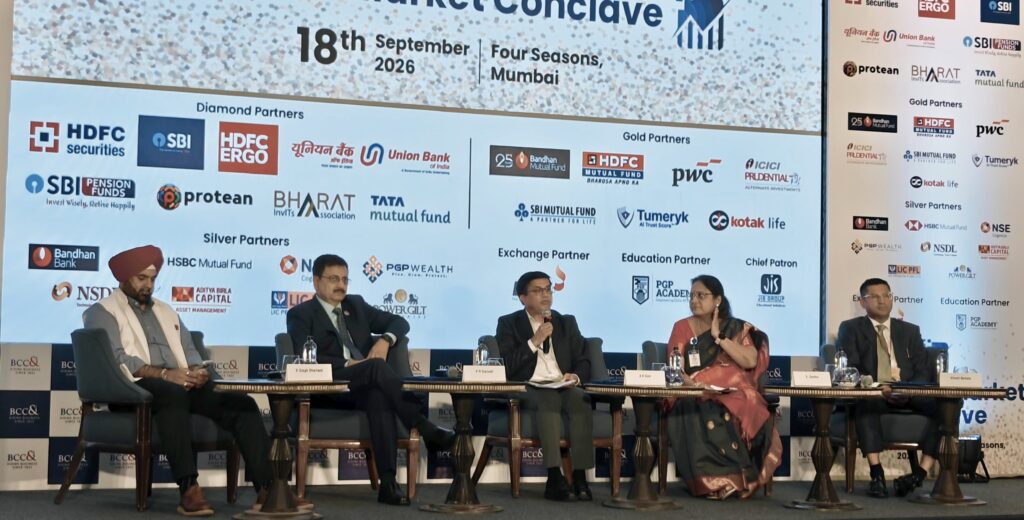
The valedictory session titled “The Long Game: Pension Funds, Patient Capital & India’s Growth Ambitions” Pranay Ranjan Dwivedi MD & CEO, SBI Pension Funds shared his valuable insights alongside Guest of Honour Shri Ashok Kumar, Executive Director, PFRDA, SBI Pension Funds• Mr. Ranbheer Singh Dhariwal, Group Head – Social Security & Welfare at Protean Technologies Ltd. & Board Member at Association of NPS Intermediaries (ANPI)• Ms. S. Geetha, MD&CEO, LIC Pension Fund• Mr. Vineet Nahata – Member CBT, EPF (Ministry of Labour & Employment), the session highlighted the critical transition of retirement savings into strategic, long-term capital to power India’s macro growth and infrastructure goals.
India’s pension sector is rapidly evolving into a vital source of “patient capital,” with long-duration funds from the National Pension System (NPS) and EPFO increasingly deployed into high-gestation national projects like green energy and infrastructure. At the core conclave session, leaders highlighted significant growth milestones, including SBI Pension Funds crossing ₹6 lakh crore in Assets Under Management (AUM), alongside the rollout of advanced digital public infrastructure by entities like Protean eGov Technologies to seamlessly manage over 10 crore subscribers. As equity limits expand to chase higher competitive returns, the emphasis remains on enforcing strict asset-liability matching and robust risk-governance frameworks to protect retirees’ primary capital.
Bridging the social security gap for India’s massive unorganised and gig workforce stands out as a critical policy priority. The panel stressed the urgency of introducing flexible micro-contribution models to help irregular earners systematically build long-term corpuses. Achieving this requires close policy convergence between the Ministry of Labour & Employment (EPFO) and PFRDA-regulated systems, effectively aligning India’s fragmented retirement vehicles into a unified domestic investment pipeline that reduces reliance on volatile external debt.

The experts’ session “Alpha in an Age of Uncertainty: Wealth Creation Strategies for the New Market Cycle”—moderated by Mr. Rahul Banerje, Founder & MD, PGP Academy and Member, Finance and Banking National Committee, BCC&I, panelists • Mr. Pawan Kumar, MD & CIO, Neo Wealth Management• Mr. Sandeep Neema, CIO, PL Capital• Mr. Piyush Chande, Senior Fund Manager – Private Capital, ICICI Prudential Mutual Fund• Mr. Stuart Erskine, Co-Founder & CEO, PlanPrompt, UK
Generating alpha in the current market cycle requires a structural shift from momentum chasing to disciplined, quality-focused portfolio construction. As macro volatility disrupts traditional asset models, panelists Pawan Kumar and Sandeep Neema emphasize that true wealth creation now hinges on rigorous stock selection, precise asset sizing, and prioritizing companies with strong fundamentals like high ROE and low debt. This public market strategy is increasingly complemented by private capital and alternative vehicles, which Piyush Chande notes are vital for capturing early-stage institutional growth as expanding Indian enterprises opt to delay public listings.
Simultaneously, India’s long-term expansion is heavily reliant on patient capital and advanced advisory tech. The panel, including Stuart Erskine, highlighted that large-scale institutional and global pension funds providing 10-to-30-year horizons are critical for funding the nation’s massive infrastructure and green transitions without being derailed by near-term volatility. While digital tools are rapidly reshaping wealth management access, the experts conclude that managing investor psychology and avoiding short-term panic remains the ultimate factor in determining whether wealth successfully compounds over a full market cycle.